TRIDENT
Reteena (reteena.org) is an applied AI lab I co-founded that builds efficient AI models for diagnosing and caring for people with neurodegenerative disease. It actually started as a Reddit post I made back in high school, when I was just looking for a few people to help me with a research project. That turned into a real team, and since then we've gotten our work published at IEEE BigData 2024, a NeurIPS 2025 workshop, and MIT URTC 2025, with support from the Microsoft for Startups program and Johns Hopkins' PAVA Center.
TRIDENT is our latest project, and it's the one I'm most excited about. It's an adaptive brain-computer interface, which means it reads neural activity and figures out what a person is trying to do, like moving a prosthetic or typing without a keyboard. The thing that makes it different is that most decoders get trained once and then frozen, so they slowly drift out of sync with your brain and need constant recalibration. TRIDENT instead reasons about your intent and keeps personalizing to you, so it gets more accurate the longer you use it and never asks you to recalibrate. Under the hood it leans on a few simple ideas working together. A transformer-style attention model watches your brain activity over a window of time, a Bayesian layer holds a running guess of what you mean and updates it on every frame, and a small set of specialized agents (one tracking timing, another tracking intent, another learning your personal neural patterns) feed into a router that decides which one to trust. All of that gets compressed down into a tiny, fast model that runs right on the device in under 20 milliseconds, with no cloud dependency.
On the logistics side, we're currently on a work plan with the Z Fellows program and are actively raising.
Tech stack
Transformer with causal self-attention
the temporal model that watches a rolling window of neural activity
Hierarchical Bayesian layer
holds a running belief about your intent and updates it every frame
Multi-agent design + attention router
separate agents for timing, intent, and your personal neural patterns, with a router that decides which to trust
Knowledge distillation
compresses the system into a small, fast student model
On-device edge inference
runs locally in under 20 ms with no cloud dependency
One-pager
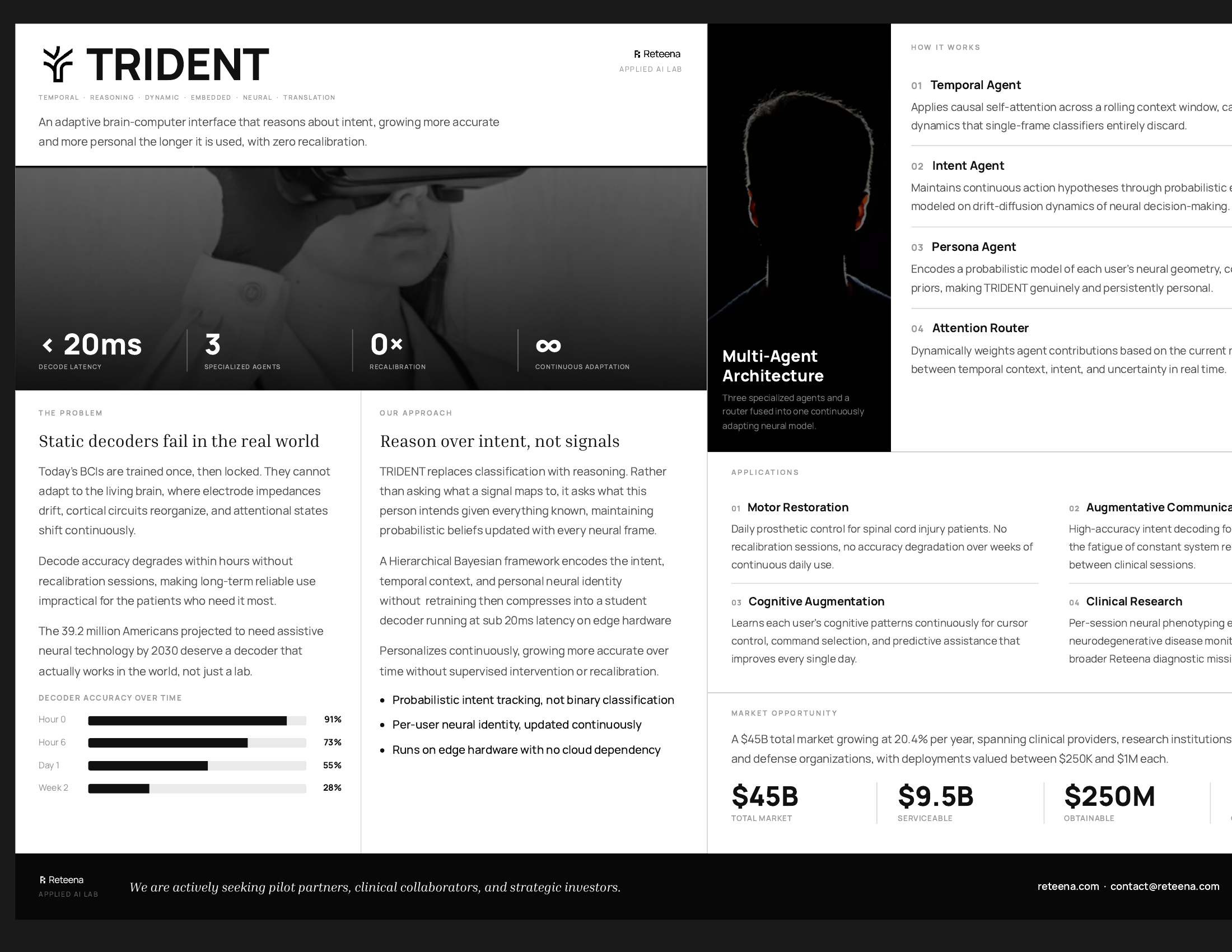
The full text, transcribed below.
TRIDENT stands for Temporal · Reasoning · Embedded · Neural · Translation
An adaptive brain-computer interface that reasons about intent, growing more accurate and more personal the longer it is used, with zero recalibration.
| Decode latency | Specialized agents | Recalibration | Continuous adaptation |
|---|---|---|---|
| under 20 ms | 3 | 0× | ∞ |
Why static decoders fail in the real world
Today's BCIs are trained once, then locked. They cannot adapt to the living brain, where cortical circuits reorganize, and attentional states shift continuously. Decode accuracy degrades within hours without recalibration sessions, making long-term reliable use impractical for the patients who need it most. The 39.2 million Americans projected to need assistive neural technology by 2030 deserve a decoder that actually works in the world, not just a lab.
How a static decoder's accuracy degrades without recalibration, shown below.
| Time | Accuracy |
|---|---|
| Hour 0 | 91% |
| Hour 6 | 73% |
| Day 1 | 55% |
| Week 2 | 28% |
Our approach, reasoning over intent rather than signals
TRIDENT replaces classification with reasoning. Rather than asking what a signal maps to, it asks what this person intends given everything known, maintaining probabilistic beliefs updated with every neural frame. A Hierarchical Bayesian framework encodes the intent, temporal context, and personal neural identity without retraining, then compresses into a student decoder running at sub-20 ms latency on edge hardware. It personalizes continuously, growing more accurate over time without supervised intervention or recalibration.
- Probabilistic intent tracking, not binary classification
- Per-user neural identity, updated continuously
- Runs on edge hardware with no cloud dependency
How the multi-agent architecture works
Three specialized agents and a router fused into one continuously adapting neural model.
- Temporal Agent applies causal self-attention across a rolling context window, capturing preparatory motor dynamics that single-frame classifiers entirely discard.
- Intent Agent maintains continuous action hypotheses through probabilistic evidence accumulation modeled on drift-diffusion dynamics of neural decision-making.
- Persona Agent encodes a probabilistic model of each user's neural geometry, cognitive state, and individual priors, making TRIDENT genuinely and persistently personal.
- Attention Router dynamically weights agent contributions based on the current neural state, shifting between temporal context, intent, and uncertainty in real time.
Market opportunity
A $45B total market growing at 20.4% per year, spanning clinical providers, research institutions, and defense organizations, with deployments valued between $250K and $1M each.
| Total market | Serviceable | Obtainable | CAGR |
|---|---|---|---|
| $45B | $9.5B | $250M | 20.4% |
Applications
- Motor Restoration, daily prosthetic control for spinal cord injury patients. No recalibration sessions, no accuracy degradation over weeks of continuous daily use.
- Augmentative Communication, high-accuracy intent decoding for ALS patients, eliminating the fatigue of constant system recalibration and re-tuning between clinical sessions.
- Cognitive Augmentation learns each user's cognitive patterns continuously for cursor control, command selection, and predictive assistance that improves every single day.
- Clinical Research, per-session neural phenotyping enables longitudinal neurodegenerative disease monitoring, aligned with the broader Reteena diagnostic mission.
We are actively seeking pilot partners, clinical collaborators, and investors. reteena.org · contact@reteena.com